
A value bet is a wager where the true probability of an outcome is higher than the probability implied by the bookmaker’s odds. In other words, the odds are offering a better price than the outcome’s actual likelihood.
Value betting in sports betting is simply identifying these mispriced odds. Here, you’ll learn how to spot value when betting, with simple examples based on real odds from BetKing, Bet9ja, Betano, and SportyBet.
By working through calculations for real matches, you’ll learn to identify value yourself rather than relying on someone else’s “value pick.”
Table of Contents
What Is a Value Bet?
A value bet exists when your estimate of an outcome’s true probability is higher than the implied probability in the bookmaker’s odds.
For example, if you think a team has a 55% chance of winning and the odds imply only 47%, you’ve found value; the price doesn’t reflect the true likelihood of the outcome. The bet can still lose, but because value is about the price rather than the result, the gap between your number and the bookmaker’s number is the entire strategy.
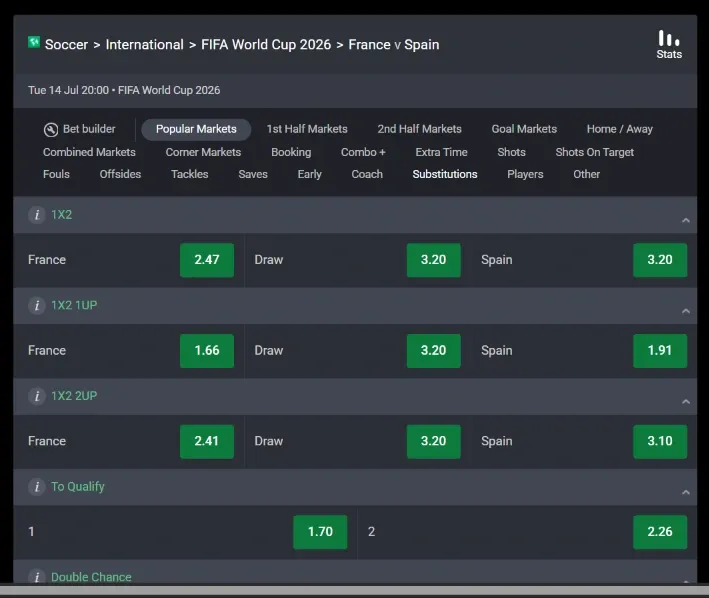
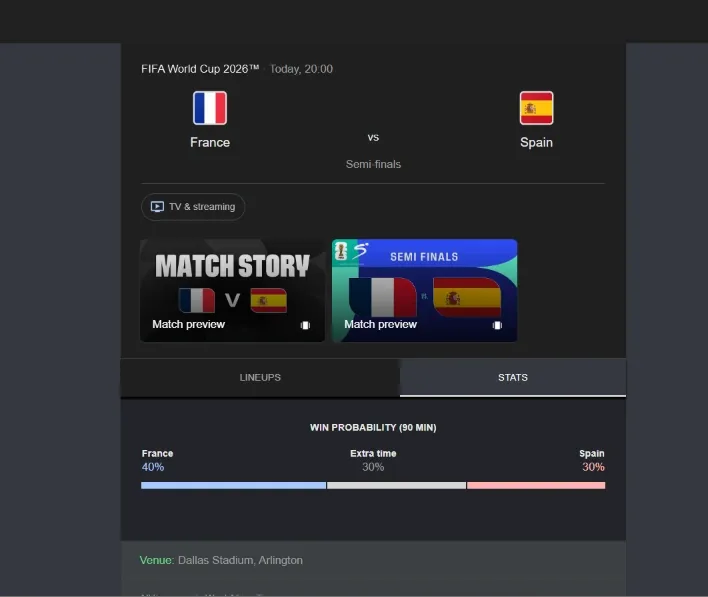
Comparing betting odds with Google’s win probability can help you spot value opportunities.
So what are value bets in practice?
Bookmakers set their odds based on their own calculations, then add a betting margin and tweak them again based on public betting patterns. Once casual bettors start betting on favourites, big names, or whatever the media narrative is, the price is pushed away from its true probability.
Value betting is about spotting when the odds underestimate an outcome and backing it before the market adjusts. When you find one, risk-free bets and other bookmaker promotions, such as the Bet9ja welcome bonus, can help you get even more value.
How Do You Calculate a Value Bet?
Value compares what you believe should happen against what the odds actually pay if you turn out to be right.
Value = (True Probability × Decimal Odds) − 1
- True Probability: your own estimate of the likelihood that the outcome will occur, expressed as a decimal (55% = 0.55), based on form, injuries, matchups, or your own model.
- Decimal Odds: the price the bookmaker is offering for that outcome, including your stake in the payout.
- The Product: multiplying probability by odds tells you the expected return per unit staked if your probability estimate is correct.
- The Result: subtracting 1 converts that return into an edge. Anything above 0 is a value bet; anything at or below 0 isn’t, regardless of how confident you feel about the pick.
This works for a single bet or an entire market. The formula only cares about the gap between your number and the bookmaker’s. Note that a result of 0.05 means a 5% edge on that specific price, not a 5% chance of winning the bet. Mixing those two up can make you overstate how good a bet actually is.
Value Bet Example on a Football Match
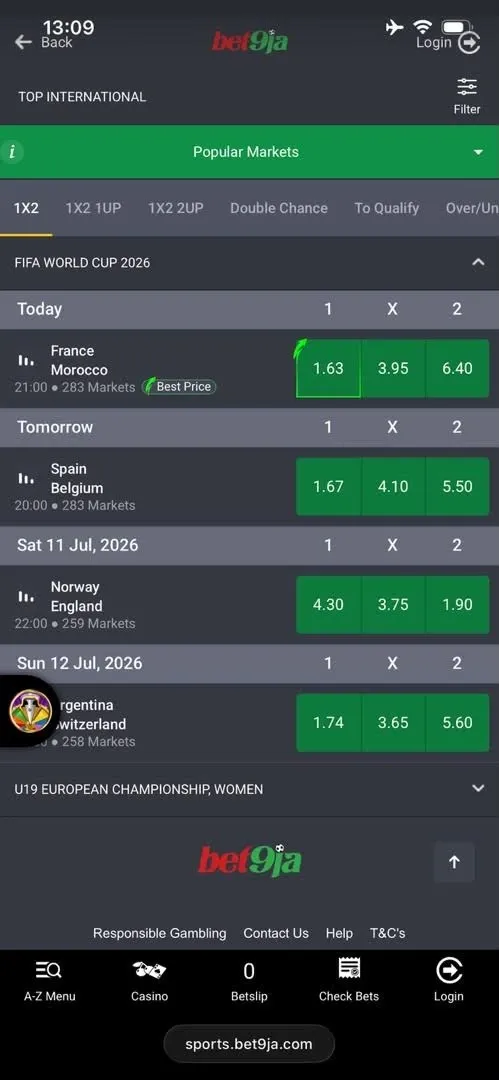
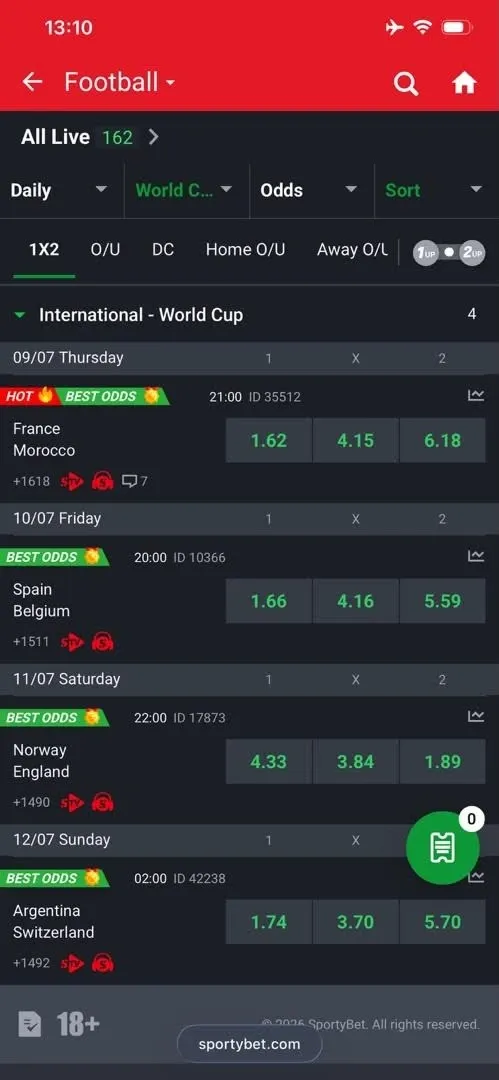
Take the 2026 World Cup quarter-final fixture that received heavy attention from Nigerian punters, such as England vs Norway, where your research points to a stronger England chance than the market is pricing in.
- Estimate the probability: Based on their run in the tournament so far, you rate England’s win chance at 60% (true probability: 0.60).
- Check the bookmaker’s price: The best odds you can find across the best Nigerian bookmakers are 1.93 at Betano for an England win.
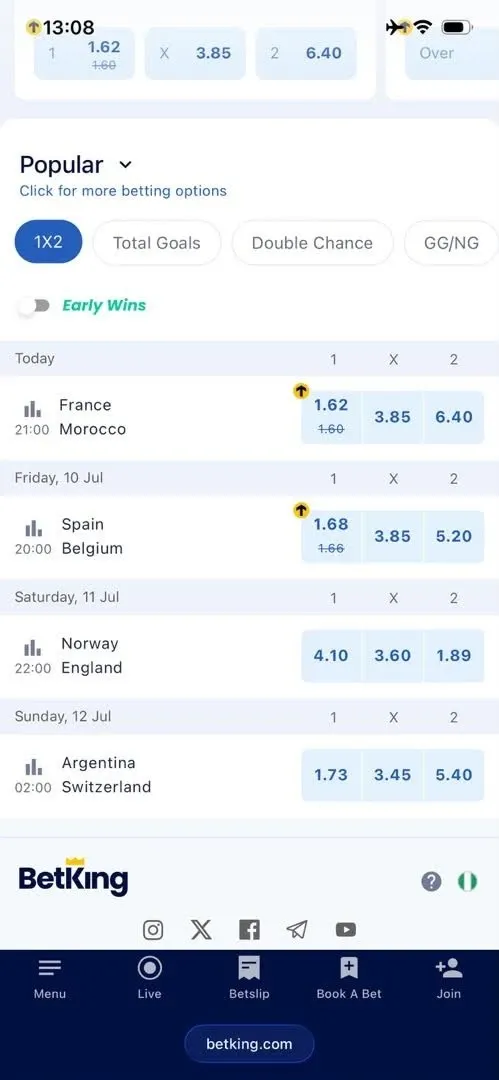
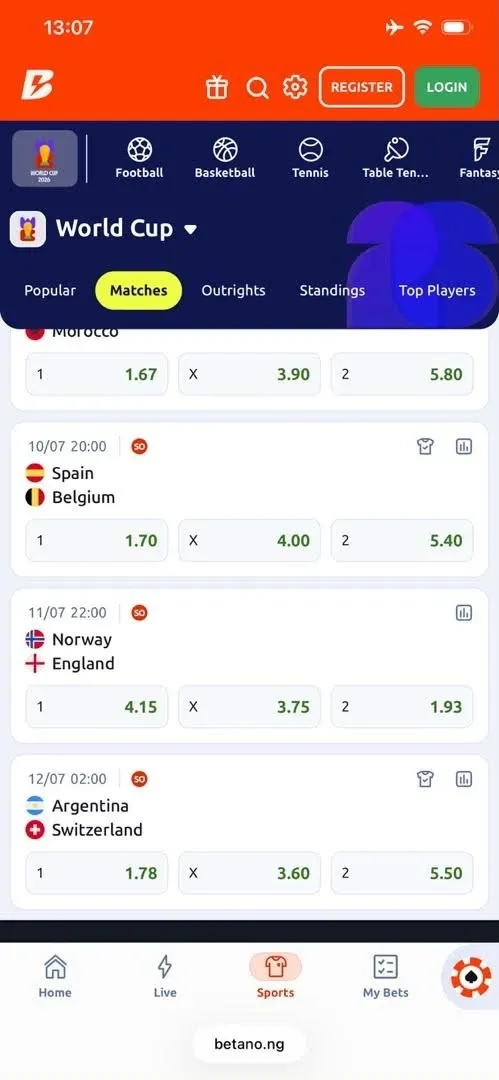
- Apply the formula: Value = (0.60 × 1.93) − 1 = 1.158 − 1 = 0.158.
- Interpret the result: A value of 0.158 is a 15.8% edge on that price. If the 60% estimate holds up, this is a bet worth backing: not because it’s guaranteed to land, but because the price pays out more than the true chance of the result justifies.
| Variable | Value used |
|---|---|
| Estimated (true) probability | 60% → 0.60 |
| Bookmaker’s decimal odds | 1.93 |
| Formula | (0.60 × 1.93) − 1 |
| Result | 0.158 (a 15.8% edge) |
What Is Expected Value (EV) and Why Does It Matter?
Expected value (EV) is the practical, profit-focused counterpart to the value bet concept. While a value bet tells you whether a bookmaker’s odds are mispriced, EV tells you what that mispricing is worth in Naira. A positive EV (+EV) means the odds are in your favour before any variance occurs, while a negative EV (-EV) means you are paying more than the risk is worth.
Variance is the natural short-term swing between expected and actual results; it’s why even good bets can lose, and poor bets can sometimes win.
For example, a +EV of 0.10 on a ₦1,000 stake means your average expected profit is ₦100 per bet over the long run, not on any individual wager. You could lose your next three bets and still turn a long-term profit because short-term results are heavily influenced by variance. That ₦100 average only emerges after placing enough bets so wins and losses balance out, and your results begin to reflect your expected value.
Implied Probability
Before judging whether a price is worth taking, you must measure your opinion and the bookmaker’s in the same units. That means using a percentage, rather than a feeling. Implied probability does that translation: it converts the odds into the market-priced chance of the outcome. If you skip this step, you’ll basically be guessing whether 1.93 (as used in the example) feels long enough. Here’s how you get there:
Implied probability = 1 ÷ Decimal Odds
So, for odds of 1.93:
- 1 ÷ 1.93 = 0.518 or 51.8%
That means the bookmaker’s odds imply a 51.8% chance of an England win. That’s the number your own estimate has to beat before there is any point going further.
Edge
Edge is the number serious bettors check first, because it tells you how far off the market is before you stake. There is no point sizing a bet on a price that was never mispriced. It is the gap between your estimated probability and the bookmaker’s implied probability:
Edge = Your Estimate − Implied Probability
So for your estimate of 60%:
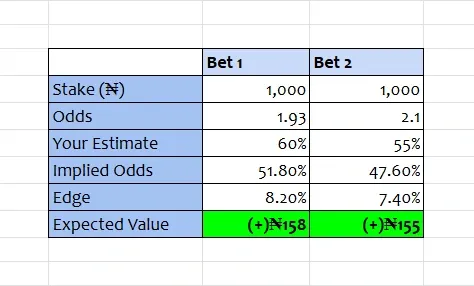
- 60% − 51.8% = +8.2%
That +8.2% is your edge, and it is the number that decides whether a price is worth acting on at all. Most experienced bettors won’t bother with anything below a 2-3% edge, since that’s roughly the error already built into most probability estimates. Anything smaller could just be noise in your own numbers rather than a genuine mispricing.
Calculating the Expected Value of a Bet
This is how you can size the EV of a bet:
EV = (Win Probability × Profit per Bet) − (Loss Probability × Stake)
Where:
- Win Probability = your estimated chance of winning (as a decimal)
- Profit per Bet = (Odds − 1) × Stake
- Loss Probability = 1 − Win Probability
- Stake = amount wagered
So, using our Norway vs England example, with a ₦1,000 stake for England to win at 1.93 odds, we can find the expected value of the bet thus:
Win Probability = 60% (0.60) | Loss Probability = 40% (0.40)
- Profit per Bet = (1.93 − 1) × ₦1,000 = 0.93 × ₦1,000 = ₦930
- EV = (0.60 × ₦930) − (0.40 × ₦1,000)
- EV = ₦558 − ₦400
- EV = +₦158.00
This is a +EV bet: at this stake and price, the maths favours you by ₦158 on average. That’s the figure to act on. A bigger EV at the same stake means a bigger edge worth committing more of your normal bankroll to. Conversely, a marginal EV close to zero is the kind of bet you either skip or stake small, because the edge is too small.
Value Bet vs Sure Bet vs Arbitrage Bet: What’s the Difference?
A value bet carries risk in exchange for a long-term mathematical edge; a sure bet (arbitrage) locks in a profit on a single event regardless of the outcome by exploiting odds discrepancies between bookmakers.
| Bet Type | Risk Level | Guaranteed Profit? | Requires |
|---|---|---|---|
| Value bet | Variance-dependent | No | Accurate probability estimation |
| Sure bet (arbitrage) | Minimal | Yes (if executed correctly) | Odds discrepancy across bookmakers |
| Standard bet | Full risk | No | Simple prediction of outcome |
Arbitrage looks safer on paper, but the price gaps big enough to lock in a profit rarely last long enough to act on. Also, bookmakers often restrict accounts that do it repeatedly.
Value betting is slower, and each bet still carries real risk, but it is more sustainable. This is one reason serious value-seeking bettors also shop odds on betting exchanges, not just traditional bookmakers. Exchanges match you against other bettors rather than the house, so they are far less likely to limit your account just for being consistently right.
How Many Value Bets Should You Place Per Day?
Most professional bettors place between 20 and 30 value bets per day, spread across multiple matches, markets, and bookmakers. That volume is what turns a small per-bet edge into a sample size large enough to pull long-term profit.
It is not a hard rule, but from my experience, that is where an edge starts to conquer variance. A 5% advantage can still lose more often than it wins over a small number of bets. Spread that edge across dozens of bets daily for weeks, and the results tilt in your favour.
Fewer bets leave you exposed to variance wiping out your bankroll, which is why discipline and proper bankroll management matter. Staking a small, consistent percentage of your bankroll per bet keeps you in the game long enough for the edge to materialise.
However, some bettors prefer to stake their full bankroll and compound winnings over a long stretch by betting on small value odds. Read our guide to rollover in betting to understand this approach better.
Using the Kelly Criterion
Many professional bettors use the Kelly Criterion to manage value bets. This method ties your stake to the strength of your edge. A bigger edge means a larger stake; a smaller edge means a smaller one. Most stick to a fraction, usually a quarter or a half, because the full formula produces swings most people cannot handle.
Pros and Cons of Value Betting
Value betting is rewarding, but it has downsides if you fail to put in the work to find genuine value. It is not a shortcut to guaranteed profit, and treating it as one only increases the risks.
Most recreational bettors lose because they bet on instinct, take whatever odds their single bookmaker offers, and never compare across platforms or exchanges. A mispriced market works in your favour only if you actively seek the edge, rather than expecting it to come to you. Over time, that discipline turns into long-term profit, even if variance determines the outcome of individual wagers.
Pros
- Mathematical edge over the bookmaker when probability estimates are accurate
- Can be applied across any sport or market where you have specialised knowledge
- Encourages a data-driven, less emotional approach to betting
Cons
- Requires consistent, disciplined probability estimation; guesswork erases the edge
- Individual bets can still lose the edge; it only plays out over a large sample size
- Time-intensive; requires research and odds comparison before every bet
Is Value Betting Worth It?
Yes, but only if you treat it as a long-term process rather than a quick way to make money. It comes down to finding odds that don’t match the true probability of an outcome, which gives you an advantage. It requires thorough research and the patience to repeat that process often enough.
With discipline, the edge shows up in your results and delivers long-term profit. It is not a system for guessing, relying on instinct, or backing the so-called safe favourite for a quick return.
Remember that short-term variance is normal. You will lose sometimes over long stretches, even when your probability estimates are accurate. What matters is whether the edge holds up across a large enough sample, which is why tracking every bet matters more than any single outcome.
Start by logging your next 50 bets before judging whether the approach is working, and only stake amounts you can afford to lose. If gambling stops feeling like entertainment, Nigeria’s Gamble Alert initiative offers free, confidential support, and all our featured licensed local bookmakers also provide responsible gambling resources through their platforms.
FAQs
What is a value bet?
A value bet is a wager where your estimated probability of an outcome is higher than the probability implied by the bookmaker’s odds.
How do you find value bets?
You find one by comparing bookmaker odds against your own calculations. For example, rating a team’s win chance at 60% (0.60) against odds of 1.93 gives Value = (0.60 × 1.93) − 1 = 0.158 — a 15.8% edge, and therefore a value bet, assuming the 60% estimate is accurate.
How many value bets should I place per day?
Professional bettors typically place 20 to 30 a day across different matches and markets, since that volume is what lets a small statistical edge show up reliably over time.
Is this strategy profitable in the long term?
Yes, but only if the underlying probability estimates are accurate and applied consistently across a large enough sample of bets.